Learn Conversational Vietnamese: 5 Minutes To Speaking Like a Local
Updated: 2 hours ago
If you're learning Vietnamese, you'll surely want to work on your Vietnamese conversational skills. Of course, we learn a language to speak it and finding a pathway to learn conversational Vietnamese is an important step toward communicating with confidence.
When you're just starting out with Vietnamese, it’s easy to feel frustrated when locals don’t seem to understand what you’re trying to say. It's also common that every single word sounds the same to you, and you can't repeat exactly what you hear. Is Vietnamese really that hard? How to learn conversational Vietnamese fast? This post will break down the exact strategies you need to unlock the language.
Is it difficult to learn basic conversational Vietnamese?

Almost every beginner has this question in mind: "Is Vietnamese a good language to learn?"
or "Is it difficult to learn Vietnamese?" While the majority of people learning Vietnamese are of Vietnamese descent, many others take up Vietnamese for a wide range of reasons, such as for travel, connection with Vietnamese communities, or simply for leisure. Learning Vietnamese is a good way to challenge your foreign language ability and explore the gateway to its culture.
For speakers of a non-tonal language (such as English or Spanish), learning Vietnamese is relatively hard due to its distinct tonal system. You have to learn the six tones in Vietnamese from scratch, not to mention struggling with distinguishing tonal variants from different dialects. On the other hand, if you are already familiar with a tonal language, learning Vietnamese will feel much more intuitive.

How long does it take to be conversational in Vietnamese?
So, how long does it take to become conversational in Vietnamese? As mentioned earlier, it depends heavily on your first language. Knowing another tonal language gives you a head start because your brain is already trained to track pitch changes for meaning. To be conversational in Vietnamese, you first need to master how the tonal system works - the most difficult part in learning Vietnamese. The rest of the journey will be incredibly simple as Vietnamese vocabulary and grammar are more straightforward than you think.
It typically takes 3 to 12 months (or about 200 to 600 hours of focused study) to reach a basic conversational level. This happens with a 1.5-hour core lesson alongside an additional 30 to 60 minutes of daily self-practice.
Here's the breakdown by proficiency level:
3 - 6 months: Basic (A1-A2) - You can master greetings, weather, counting, ordering food, and giving basic directions
6 -12 months: Basic conversational (B1-B2) - You can comfortably handle everyday topics and most social situations
1,100+ hours or 3+ years: Advanced fluency (C1+): You can discuss complex topics, understand regional accents, and express nuanced thoughts
Best ways to learn conversational Vietnamese
Learning to speak Vietnamese fluently requires practical practice over passive study. Below are the best approaches to help you start speaking authentic Vietnamese with confidence.
Practice makes perfect
There is no shortcut to fluent Vietnamese. From basic survival level to comfortable conversational, you need consistent daily effort. The language you learn from traditional textbooks is also relatively different from the spoken language, so it takes more time to understand real-life conversations.
Don't take free resources to learn Vietnamese for granted. They can be language sites, travel vlogs, podcasts or movies with commonly used Vietnamese phrases and expressions. You can also explore specific regional dialects, such as Northern (Hanoi) or Southern (Saigon) using dialect-specific resources.
Talk to yourself in Vietnamese
Short on time? Self-narration is a simple habit you can practice anytime, anywhere. Talk through your daily routine out loud in Vietnamese. For example, name the objects you use as you get ready in the morning or talk through your daily plans as you sip your morning coffee. Speaking out loud to yourself helps break through the initial friction of talking, building the confidence you need for real conversations.
Listen back to your exercises
It's not uncommon to think you speak the right word, but locals can't understand you at all. A minor tonal shift can change the meaning of the whole sentence you are about to say, even just a simple greeting. To help you hear what you're speaking and improve your spoken Vietnamese over time, try recording yourself speaking and listening back. By doing that, you can easily spot pitch mistakes, compare your pronunciation to native speakers, and refine your tones.
Drill dialogues

Listening to dialogues and using dialogue exercises can help you improve your listening skills in Vietnamese. Hearing native speakers chat is a good way to improve recognition of tones and speed up listening comprehension. In dialogues, you will also learn how Vietnamese speakers "soften" their speech by using a range of particles such as "nha", "nhé", "ạ" etc.
It's also recommended that you listen to dialogues that are related to your current level and the topic that you're learning. This will allow you to know how the words are used in real context rather than abstract rules.
Take advantage of the apps
A great Vietnamese learning app will help you build confidence in everyday communication, possibly with feedback on pronunciation that you can understand. Many apps also focus on gamified habits while others offer real-world situations and natural dialogues. Here are some suggestions:
Duolingo: Duolingo is one of the best apps to learn conversational Vietnamese. With short lessons ideal for daily routines and a strong streak system keeping motivation high, this app is best for learners who want a playful introduction before shifting to more advanced learning.
Migaku: This app helps you achieve fluency through immersion with everyday media like Netflix, YouTube, web pages, and books. Their key features include interactive subtitles, flashcards, and their spaced repetition system.
Vietnamese Pod101: This is suitable for learners seeking bite-sized audio and video lessons (3-15 mins) taught by real teachers. They also provide word lists, slideshows, and flashcards for learning Vietnamese more effectively.
Ling: This app offers plenty of fun mini-games and exercises for various proficiency levels to improve your reading and listening skills and expand your vocabulary. This can be an alternative to Duolingo's gamified, low-commitment style.
Learn with a Vietnamese tutor
Consider learning with a Vietnamese tutor if you need real-time correction of pronunciation and need to delve deeper into the cultural nuances that shape real Vietnamese conversations. One major advantage of private tutors is their ability to tailor lessons to your specific goals—whether for travel, casual communication, or business—while regular weekly sessions keep you accountable and build momentum. Many Vietnamese tutors are available at italki, Preply, Amazing Talker.
Learn on the go with music
Together with audio news and podcasts, you can get Vietnamese listening practice on the go with Vietnamese-language music. Music helps you master slang and become accustomed to Vietnamese poetry and metaphor. Catchy rhythms and repetition also let words stick in your brain so you can recall later. Check out best Vietnamese songs to learn and famous Vietnamese love songs with lyrics.
Vietnamese conversations by topic for beginners
To master conversational Vietnamese fast, prioritize practical dialogues over isolated vocabulary lists. Working with real Vietnamese conversation audio trains your brain to recognize sentence patterns, tone flow, and natural context instantly. Explore some of the most common topics for beginners below.
1. Basic greetings
First impressions matter, especially when meeting your partner's family. This sample dialogue walks you through an authentic Vietnamese greeting, showing you how to use polite pronouns and natural phrasing.
-Dạ, con chào bác!
-Chào con! Con tên gì?
-Dạ, con tên là Minh. Con là bạn trai của Linh.
-À, chào Minh! Vào nhà ngồi chơi đi con.
-Dạ con cảm ơn bác. Bác khỏe không ạ?
-Bác khỏe. Con cũng khỏe hả?
-Dạ con cũng khỏe. Bác đang làm gì vậy?
-Bác đang xem tin tức. Con ở xa đây không?
-Dạ cũng không xa lắm đâu bác. Mất khoảng 30 phút thôi ạ.
-Hello, sir!
-Hello! What's your name?
-My name is Minh. I'm Linh's boyfriend.
-Oh, hello Minh! Come in and sit down.
-Thank you. How are you?
-I'm doing well. You’re fine?
-Sure. What are you doing?
-I'm watching the news. Do you live far from here?
-Not at all. Only 30 minutes to get here.
2. At the restaurant
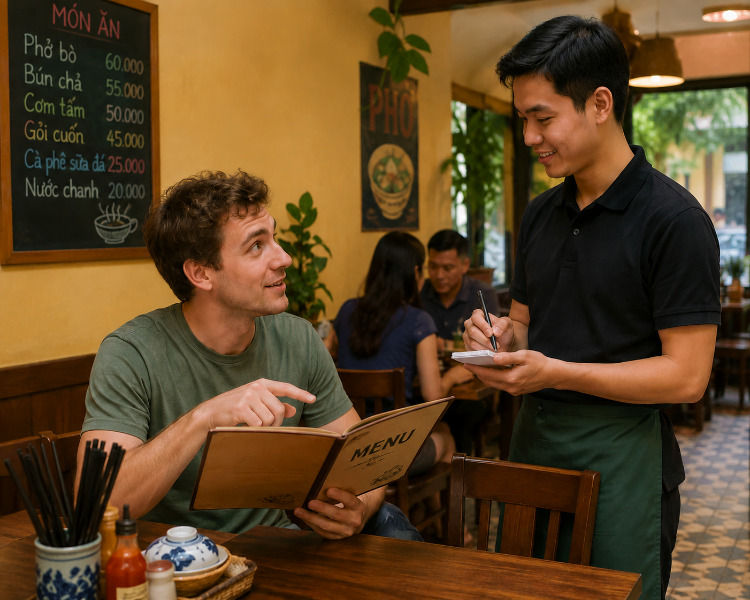
This is a conversation between a loving couple using terms of endearment and informal language. Listen and explore how to say "my love" in Vietnamese.
-Hôm nay mình ăn gì đây, cục cưng? Thực đơn nhiều món quá, em chọn đi.
-Để em xem qua đã... Anh thích ăn gì nào, lẩu hay đồ nướng?
-Anh sao cũng được, chiều theo ý em thôi. Nhưng anh nghe nói quán này nổi tiếng món lẩu Thái đó cưng.
-Vậy mình gọi lẩu Thái đi anh! Lâu rồi mình chưa ăn lẩu chung.
-Ô-kê em yêu, để anh gọi phục vụ.
-What should we eat today, sweetheart? The menu has so many dishes — you pick.
-Let me look through it first... What do you feel like eating, hotpot or grilled food?
-I'm fine with anything, I'll go along with what you want. But I heard this place is famous for its Thai hotpot, babe.
-Then let's order Thai hotpot! It's been a while since we had hotpot together.
-Okay my love, let me call the waiter.
3. Travel in Vietnam
This is a conversation between a traveler and a local, asking how to get to a place. In this conversation, you can learn basic greetings and polite phrases.
-Xin chào! Tôi không biết nói tiếng Việt, bạn có nói được tiếng Anh không?
-Chào anh! Tôi nói được một chút tiếng Anh thôi. Anh cần giúp gì không?
-Tôi muốn đi đến Hồ Hoàn Kiếm. Bạn chỉ tôi đường đến đó được không?
-Được chứ! Anh có thể bắt xe buýt ở trạm đằng kia, khoảng 30 phút thôi sẽ đến.
-Cảm ơn bạn nhiều! Còn taxi thì sao?
-Taxi sẽ hơi đắt hơn một chút. Anh có thể đặt Grab bằng ứng dụng trên điện thoại.
-Ồ, bạn tốt bụng quá. Cảm ơn lần nữa nhé.
-Không có gì đâu ạ.
-Hello! I don't speak Vietnamese. Do you speak English?
-Hi! Yes, I speak a little English. How can I help you?
-I'd like to go to Ben Thanh Market. Could you give me directions there?
-Of course! You can catch a bus at the stop over there; it'll take about 30 minutes to get there.
-Thank you so much! What about a taxi?
-A taxi will be a bit more expensive. You can book a Grab using the app on your phone.
-Oh, you're so kind. Thanks again!
-You're welcome.
There are many different ways to learn conversational Vietnamese, from learning apps, websites, and tools to speaking with a native speaker. However, no single resource works for everyone. The secret to fast progress is finding the flow of the language, testing different methods and finding the exact combination that suits your goals.
Practice Time
Ready to level up? Dive into our Free Resource Library — free audios, worksheets, games, and practice materials to help you learn faster.