Common Greetings in Vietnamese: Best Ways to Start a Thoughtful Conversation
Updated: 1 day ago
Why do you rarely hear native speakers saying “xin chào” to each other? In fact, common greetings in Vietnamese start with “chào” followed by a pronoun and can be used with “dạ” or “ạ” to emphasize respect.
In Vietnam, a greeting is rarely just a word; it’s a reflection of relationship, respect, and community. From learning basic Vietnamese phrases on day one to informal street catchphrases, here is your essential guide to greeting anyone in Vietnam with confidence.
Understand greetings in Vietnamese

Greetings are a crucial part of Vietnamese culture. No matter what your Vietnamese level is, you can start any conversation with thoughtful greetings in different situations.
How important are greetings in Vietnamese?
Greetings carry deep cultural significance that Vietnamese people often say “Lời chào cao hơn mâm cỗ” (A respectful greeting is worth more than a feast) or “Lời chào là đầu câu chuyện” (Every conversation begins with a greeting). In different communicative situations, we choose different ways of greeting, from close, casual to formal and polite.
In Vietnamese, greetings are also an occasion for speakers to express emotion, attitude, and care between the people involved in the communication. The way people greet one another depends on the closeness of their relationship, the level of care and respect they wish to express, and, to some extent, regional differences.
Formal vs informal greetings
Formal greetings in Vietnamese show respect to elderly people or in a business context. This is shown in the use of Vietnamese pronouns and interjections, such as “dạ” or “ạ”. Using the appropriate forms helps convey politeness and cultural awareness regardless of your language proficiency.
Other than formal contexts, Vietnamese people use greetings to signal their friendliness and openness for a conversation. Rather than indicating hierarchy or seniority, informal greetings can simply be considered an expression of closeness. This is common among family members and friends.
In Vietnam, those who want to leave a good first impression on someone they've just met can simply start with a smile and a simple greeting.
You may also be interested in Basic Vietnamese Phrases for Travel
How to greet a Vietnamese person?

Common greetings in Vietnamese
Common greetings in Vietnam follow the same pattern: Chào (greetings) + pronoun/name. For a full structure to say hello in Vietnamese (highly recommend using a full sentence when speaking to the elderly), you can add “I”, and chào then functions as a verb, meaning " to greet. Remember that you have to change I to fit the context.
Example:
Chào anh! – greetings to a man a bit older than you
Chào em! – greetings to someone a bit younger than you
Cô chào con! – you (female) saying hello to someone around your child’s age
Cháu chào ông! – you saying hello to someone around your grandpa’s age
To sound more formal or polite, you can add "ạ" at the end of the greeting, "dạ" at the beginning, or combine both for extra respect. Keep in mind, though, this only applies to a situation when you are talking to someone older than you.
Example:
Cháu chào ông ạ!
Dạ em chào anh!
Dạ em chào anh ạ!
When responding, simply mirror the pronoun pair the speaker used but swap the roles.
Example:
-Em chào anh ạ!
-Anh chào em! (In this case, you are “anh”, who is older than “em”, so there’s no need to use “ạ”.)
Nowadays, many young Vietnamese enjoy mixing English and Vietnamese to keep conversations feeling fresh and trendy. So don't be surprised to hear things like "Hi em" or "Hello anh" in casual, everyday chats.
Greetings in business communication
When meeting business partners, always opt for the formal form – position yourself humbly while addressing the other person with a high degree of respect.
Example:
Chào anh Nam! (Hello, Mr. Nam!)
Chào cô Thủy! (Hello, Ms. Thủy!)
Chào tất cả mọi người! (Hello everyone!)
Chào tất cả anh chị em trong công ty! (Hello to everyone at the company!)
Read more on How to say in Vietnamese: 50 Shades of “I”
Going beyond “hello”
All of the greetings above are just to say “hello,” but what comes next? This is when a Vietnamese conversation moves to polite questions. Let’s look at a few ways to move forward:
Em khỏe không? (How are you?)
Anh đi đâu đấy? (Where are you going?)
Dạo này chị thế nào? (How are you doing?)
Mọi việc vẫn ổn chứ? (Is everything okay?)
In specific contexts, greetings can be questions to ask what the other speaker is doing. If it’s the case, you can jump straight to the question and omit the structure “Chào…”
Example:
Chị đọc sách ạ? (Are you reading a book?)
Chú xem vô tuyến ạ? (Are you watching TV?)
Em ăn tối hả? (Are you having dinner?)
In Vietnamese, you can use exactly the same structure “Chào…” in saying hello to say farewell to other people.
Example:
-Chào ba, con về ạ. (Bye, Dad. I have to go now.)
-Chào cháu, cô phải đi rồi. (Bye, sweetie. I have to go now.)
Greetings in Vietnamese on special occasions
Beyond everyday hellos, Vietnamese has special greetings reserved for holidays and celebrations. Here's how to greet like a local during two of the most meaningful occasions of the year.
Lunar New Year greetings in Vietnamese

Tết or Vietnamese Lunar New Year is the most important holiday of the year, and family members gather together to exchange best wishes. If you’ve recently become part of a Vietnamese family, try to say Chúc mừng năm mới [pronunciation: chook (high rising), moong (low falling), num (flat mid), and moy (high rising)]. This is how locals greet each other during Tết – the universal greeting that everyone understands.
Unlike in English, the Happy New Year in Vietnamese greetings are often customized to the person you’re speaking to, and again, to show respect.
For example:
Chúc mừng năm mới ông!
Chúc mừng năm mới cả nhà!
Christmas greetings in Vietnamese

Although Christmas isn’t a traditional holiday in Vietnam, it’s becoming increasingly popular in big cities, and you can still celebrate it as a fun occasion. The most common greeting in Vietnamese for Christmas is Giáng sinh vui vẻ [pronunciation: Zahng (high rising) sin (flat mid) vwee (flat mid) veh (dipping rising)] meaning Merry Christmas.
You can customize the message to send it to different people using this structure: “Chúc + pronoun + giáng sinh vui vẻ”.
For example:
Chúc em giáng sinh vui vẻ!
Chúc mẹ giáng sinh vui vẻ!
Greetings in conversation

To put everything you have learned so far into practice, try out these sample conversations and see how the greetings come together in real life.
Common greetings in Vietnamese 1
Conversation for greeting your partner's family conversation
-You: Dạ, con chào bác ạ! (Hello, sir!)
-Partner's father: Chào con! Con tên gì? (Hello! What's your name?)
-You: Dạ, con tên là Minh ạ. Con là bạn trai của Linh. (My name is Minh. I'm Linh's boyfriend.)
-Partner's mother: Ồ, chào Minh! Vào nhà ngồi chơi đi con. (Oh, hello Minh! Come in and sit down.)
-You: Dạ con cảm ơn bác. Hai bác khỏe không ạ? (Thank you. How are you?)
-Partner’s father: Hai bác khỏe. Con cũng khỏe hả? (We’re doing well. You’re fine?)
-You: Dạ con cũng khỏe. Hai bác ăn cơm chưa? (Sure. Have you eaten yet?)
Role-play to practice using common greetings in Southern Vietnamese conversation here
Common greetings in Vietnamese 2
Conversation for greeting a new colleague
-New colleague: Chào anh! Em là Trang. Hôm nay em mới vào làm ạ. (Hi! I’m Trang. Today is my first day at work.)
-You: Chào Trang. Rất vui được làm quen với em. Anh là Tân. Em làm ở bộ phận nào? (Hi Trang! Nice to meet you. I’m Tan. Which department do you work in?)
-New colleague: Em cũng rất vui được làm quen với anh ạ. Em làm ở bộ phận kế toán. Thế còn anh? (Nice to meet you too. I work in the accounting department. How about you?)
-You: Anh làm ở phòng nhân sự. Nếu cần hỗ trợ gì cứ nói anh nhé! (I work in HR. Feel free to tell me if you need any support!)
-New colleague: Dạ vâng. Cảm ơn anh. Em sẽ cần nhờ anh và mọi người trong team giúp đỡ nhiều ạ. (Of course. Thank you. I'll need to rely on you and everyone on the team for help.)
Common greetings in Vietnamese 3
Conversation for greeting an acquaintance on the street
-Acquaintance: Ơ, chào chị! Lâu rồi không gặp chị! (Oh, hi! Long time no see!)
-You: Chào em! Dạo này em sao rồi? (Hi! How have you been lately?)
-Acquaintance: Em cũng hơi bận chị ạ. Chị đi đâu đấy? (I'm a bit busy. Where are you headed to?)
-You: Chị đi mua ít đồ ăn. Công việc của em vẫn ổn hả? (I'm just out to buy some groceries. Is your work still going smoothly?)
-Acquaintance: Dạ, cũng ổn chị ạ. Khi nào rảnh chị em mình đi cà phê nhé! (It's going well, thanks. Let's grab coffee sometime when you're free!)
-You: Ừ, được đó! Em cho chị xin số điện thoại đi để tiện liên lạc. (Sure, sounds good! Give me your number for easier communication.)
See how greetings vary depending on the context? You should practice with more real-life materials to get a better feel for how native speakers communicate. Read more on best free online resources to learn Vietnamese.
Notes for greetings in Vietnamese
How you use common greetings in Vietnamese isn’t just about learning a fixed sentence structure, it’s about learning some language notes to sound more like a native speaker -
Do Vietnamese people say “Good morning/ Good afternoon/ Good evening”?
In real-life conversations, time-based expressions are not common greetings in Vietnamese. Instead of saying “Chào buổi sáng” (Good morning), Vietnamese prefer to use question-style greetings, such as “Em ăn sáng chưa?”, "Em ăn sáng với bánh mì hả?", or “Em đi đây đấy?”
What is “Xin chào”?
Xin chào is a neutral translation for “Hello”. It's typically used when addressing a group, a stranger, or in formal contexts where you don't know the listener's age or relationship to you. This is a safe, one-size-fits-all option for someone learning Vietnamese from the beginning. However, in casual conversations, xin chào sounds overly formal and doesn’t and doesn't carry the warmth or closeness that everyday greetings usually have.
What is the difference between “Chào” and “Thưa”?
In Vietnamese, they say “Đi hỏi về chào” (before leaving, ask for permission; when coming back, greet) or “Đi thưa về trình” (before leaving, inform respectfully; when returning, announce yourself). This is the communication rule that they teach children from a very young age.
Chào is used to greet someone or to say good-bye to them; it’s a broad greeting that can be used to talk to anyone (it’s better to add “dạ” when speaking to the elderly).
Thưa is more common in Southern Vietnam, and it is used to talk to elderly people. This word can be translated as “to inform”, so it acts like an update on your activities; that’s why you will hear people say “Thưa ba con mới tới” (Hello Dad, I've just arrived) or “Thưa mẹ con mới đi học về” (Mom, I'm home from school).
How to practice greetings in Vietnamese
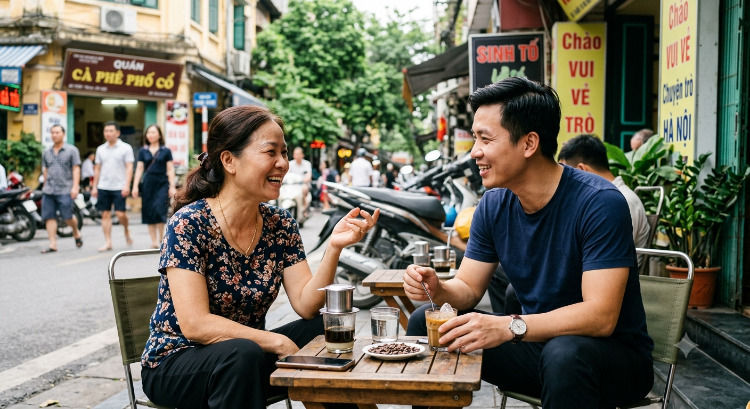
You will need to use a variety of greetings in Vietnamese conversations, so try to learn to structure a suitable greeting for different situations. It’s also worth reviewing Vietnamese pronouns and tones for better communication.
Build a pronoun selection matrix
Mastering greetings requires knowing which pronoun matches the listener's age, gender, and social status relative to the speaker. Map out everyday pairings so you can see the direct relationship. For example:
I | you | |
speaking to an older man | em | anh |
speaking to an older woman | em | chị |
speaking to someone younger | anh/chị | em |
Pay attention to the tones
Practicing differentiating six tones in Vietnamese since greeting words change meaning entirely if the tone is incorrect. The most important word in this structure is obviously Chào (falling tone). Always add a tone instead of flattening it so that you can make it comprehensible.
Watch out: Different tones mean different words:
chao (tofu cheese)
chào (to greet)
cháo (porridge)
chảo (frying pan)
chạo (minced meat paste wrapped around sugarcane)
Read more on Common Mistakes Non-Native Speakers Usually Make
Vietnamese language exchange
Put theory into practice by connecting with native Vietnamese speakers through interactive setups. Start every language exchange session using only Vietnamese greetings, choosing the correct pronouns for your partner based on their age. Here are some suggestions:
Whether you're talking to a stranger or chatting with friends, the use of common greetings in Vietnamese with suitable pronouns matters significantly. Even if your pronunciation isn't perfect, locals deeply appreciate the effort. Start with the basics, embrace the tones, and enjoy the warm hospitality that follows every “chào”.