How to say "I" in Vietnamese? Em, Mình, Tao, Con... Which "I" Are You Today?
Updated: 6 days ago
There's no "one-I-fits-all" in Vietnamese, you must change the pronoun based on age, gender, or level of closeness. How to say I in Vietnamese? The way you introduce yourself as em, mình, tao, con, chị, anh, or a dozen other options will carry its own shade of emotion and relationship.
If English has just one "I", Vietnamese has dozens. "I" can be as soft as em, or as blunt as tao. Choosing the right "I" isn't just about grammar — it's about politeness, closeness, and where you stand in the relationship. This post will break down the most common ways to say "I" in Vietnamese, what each one signals, and how to pick the right one every time.
Different ways to address yourself in Vietnamese
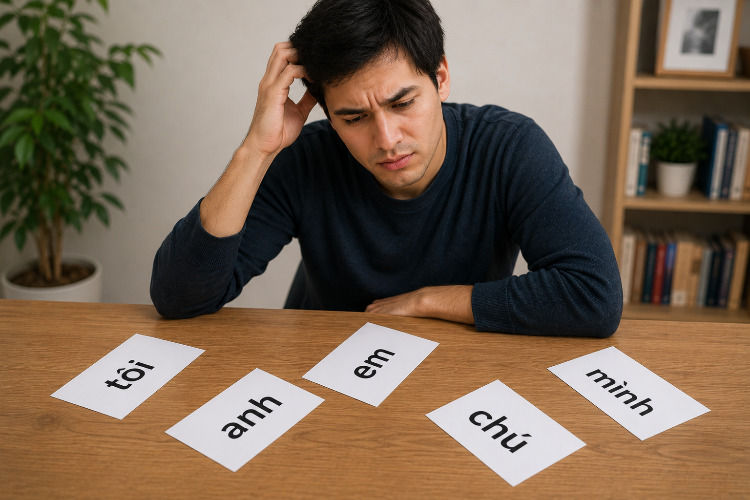
As you are progressing from basic Vietnamese phrases to conversational fluency, choosing the right word for "I" is not optional. Vietnam has deep respect for hierarchy and relationships, so the way you use I needs to be adjusted depending on who you're speaking to, your relationship with them, and even your gender or age relative to theirs.
How to say I in Vietnamese to family members
In Vietnamese families, you will speak from your position in the family tree. The word you use for yourself directly mirrors the word you'd use to address the other person.
Speaking to your parent: you call yourself "con" (child), and call them "mẹ" (mom) or "ba" (dad)
Speaking to your older sibling: you call yourself "em" (younger one), and call them "anh" (older brother) or "chị" (older sister)
Speaking to your grandparent: you call yourself "cháu" (grandchild) or "con", and call them "ông" (grandpa) or "bà" (grandma)
Speaking to your relative: you call yourself "cháu" (niece/nephew) or "con", and call them "cô", "dì", "bác" (aunt) or "chú", "cậu", "dượng", "bác" (uncle)
Vietnamese also differentiates relatives by the father's side (bên nội) and the mother's side (bên ngoại), so make sure you learn some essential phrases to refer to people exactly. For example, an aunt by the father's side can be "cô" and by the mother's side can be "dì".
It's also important to note that the Northern, Central, and Southern regions have a different set of vocabulary to refer to some family members. These regional differences may confuse you when you're learning Vietnamese from one region but then travel to, or interact with people from another.
Nothern | Central | Southern | |
Father | bố (common) - thầy | ba (common) - cha - tía | ba (common) - cha - tía |
Mother | mẹ (common) - u -mợ | mạ - má - mệ | mẹ (common) - má |
Example: A conversation in a northern Vietnamese family can be like this:
-Ông: Sơn ơi, bố cháu đâu rồi?(Where's your dad, Sơn?)
-Sơn: Dạ, bố cháu đang làm vườn ạ. (He's doing gardening, grandpa.)
-Ông: Thế à? Cháu ra gọi bố vào ăn cơm với ông cháu mình đi. (Oh really? Call your dad to enjoy the meal with us.)
-Sơn: Vâng ạ, cháu đi gọi bố ngay đây ạ. (Sure, I'll call him right away.)
Addressing yourself and other family members is important to show respect and maintain harmony within the family hierarchy, especially during family gatherings in Lunar New Year — Vietnam's biggest holiday symbolizing family reunions. Remember to learn how to say Happy New Year with correct tones and pronouns.
Try this conversation role-play game to practice using the correct Vietnamese pronouns for "I" in family introductions.

Expressing I in romantic relationships

"I" in romantic relationships express closeness and affection with the most common pair being "anh - em". Typically, the man refers to himself as "anh" while the woman refers to herself as "em", even if they are the same age or the woman is older. Rather than indicating age, these pronouns reflect intimacy and a caring, affectionate relationship. Traditionally, "anh" suggests a caring and protective role, while "em" expresses closeness and tenderness within the relationship. Choosing the correct pronouns will help you express love in Vietnamese much more easily.
Example:
"Anh yêu em nhiều lắm." (I love you so much.)
"Lát nữa em gọi lại cho anh nhé, anh yêu!" (I'll call you back later, my love!)
After getting married, the couple can either continue saying "anh - em" or switch to another pair "chồng (husband) - vợ (wife)." Both forms are natural and commonly used in everyday Vietnamese.
Example:
-Huy: Vợ ơi, tối nay mình ăn ngoài nhé? (Honey, how about eating out tonight?)
-Lan: Hay đó nhưng để vợ nấu cũng được mà. (That sounds great, but it's okay if I cook.)
-Huy: Thôi, hôm nay để chồng đãi vợ một bữa chứ. (No, let me treat you to dinner.)
-Lan: Cảm ơn chồng nhiều. Vậy 7 giờ mình đi nhé! (Thanks, honey. Let's go at 7 p.m.)
Choosing the right I when talking to friends
Among friends, Vietnamese becomes more relaxed, but age still plays a role. In general, you can refer to yourself as "mình" and address the other person as "bạn" if you assume they are around your age. Specifically in the northern dialect, I and you in terms of friends can be translated as "tớ" and "cậu" while in the southern dialect, the common pair is "tui - bà" (the other speaker is female) or "tui-ông" (the other speaker is male).
Example:
"Hôm nay mình sẽ giới thiệu với các bạn cách nấu món phở." (Today, I'm going to show you how to make phở.) — This way of using I is common for YouTube content.
"Cậu cứ tự nhiên như ở nhà nhé. Giờ tớ phải ra ngoài có chút việc." (Make yourself at home. I have to go out for a little while.)
"Tui muốn mời bà qua nhà tui ăn sinh nhật." (I want to invite you to my place to celebrate my birthday.) — This is commonly used among close friends.
Now, when there's an age gap between you and your friends, the pronouns may shift. Since respect plays an important role in Vietnamese culture, you'll usually choose pronouns based on the other person's age and your relationship with them. The use of "em", "anh", "chị" is best to address yourself and refer to the other speaker.
"I" in Vietnamese | The other speaker |
em | anh (male, older than you) |
em | chị (female, older than you) |
anh (male) chị (female) | em (someone younger than you) |
Example:
-Thủy: Em nghe nói dạo này anh khá bận phải không? (I heard you've been pretty busy lately, haven't you?)
-Nam: Phải, dạo này anh phải tập trung cho dự án mới nên không có nhiều thời gian. (Yes. I've been focusing on a new project recently, so I haven't had much free time.)
With close friends in a very informal language, you can use "tao". This sounds intimate and casual, but the pair "tao-mày" should only be applied to friends around your age or those younger than you. For example, two university classmates who've known each other for years might say, "Tao đói quá, mày ăn chưa?" ("I'm starving, have you eaten?").
How to say I in Vietnamese to colleagues

In the workplace, the tone shifts toward formality. The safest approach is to use polite forms of address first and adjust later as you become familiar with the company's culture. Avoid addressing people too casually or choosing pronouns based solely on your first impression.
For the first day at work, if you're unsure how to address a colleague, it's generally safe to call an older male colleague "anh" and an older female colleague "chị" and refer to yourself as "em". This shows respect and helps create a positive first impression. Later, your coworker may ask for your age so that you can choose a suitable way to say I.
In terms of respect in the workplace, age often takes priority over position. That means you would normally address an older person as "anh" or "chị" and address yourself "em", even if they are your subordinates. Likewise, if your manager is younger than you, they may still encourage you to call them "em" instead of using a more senior pronoun.
When to use "tôi"?
In fact, using "I" in Vietnamese as "tôi" is not very common among Vietnamese, and it does not create a personal connection between speakers. You can use "tôi" in a strictly formal context, such as business meetings, official emails, or public speeches, where neutrality matters more than warmth. In most professional settings, people naturally shift to age-based terms.
How to say I in Vietnamese to strangers
As mentioned earlier, the Vietnamese pronoun system is based on age and relationship. For strangers whom you may not be able to ask for age or define the relationship, the safest approach is to use polite forms of address. Remember the rule in Vietnamese: Xưng khiêm hô tôn. (Address others respectfully and refer to yourself humbly.)
Some pronoun pairs to consider when speaking to strangers:
em - anh (male) / chị (female). If you feel like the other speaker is younger than you, you can address yourself as "mình" and keep calling them "anh" or "chị".
con/ cháu - chú (male, your parents' age) / cô (female, your parents' age)
con/ cháu - ông (male, your grandparents' age) / bà (female, your grandparents' age)
Tips to say I in Vietnamese correctly
You think Vietnamese pronouns are too complicated? Yes, they are. Actually, native Vietnamese are also confused by pronouns when it comes to greeting other people. Choosing the correct way to say I in Vietnamese is the first step you need to complete before starting a real conversation.
Master the tones

When you can rest assured about the pronoun to be used, here comes the next challenge: Say it correctly! With six distinctly different tones, pronouncing the words the way you mean it can be tough. Make sure you won't mix up "tôi" with similar-sounding words, such as "tồi" (bad) or tội (guilty).
Practicing the Vietnamese six tones alongside pronouns will help you sound natural and avoid embarrassing mix-ups. Don't worry, since tones are the hardest part of learning Vietnamese; after this, the rest of your language journey will be as easy as a piece of cake.
Read more on Common Mistakes Non-Native Speakers Make
Pay attention to level of closeness
How to say I in Vietnamese? Before jumping to which I to use, ask yourself these questions: How old is this person relative to me? How close are we? Is this a formal or casual setting? These three questions will guide you to the right word almost every time. When in doubt, the neutral "tôi" is a safe, neutral fallback for non-native speakers.
Choosing the right word for "I" is about expressing the right level of warmth, familiarity, and respect. As your relationship with someone changes, the pronouns you use may change as well. Learning to recognize these social cues will help you sound much more natural when speaking Vietnamese.
Consider using your name instead of saying I
Vietnamese has another unique way of saying "I"—by using your own name instead of a pronoun. Within families, siblings or cousins may refer to themselves by their names when talking to one another.
In other contexts, using your name instead of pronouns makes the conversation more expressive or also emphasizes identity since names hold a special meaning to each individual.
Example:
-Hạnh: Khoa ơi, tối nay Khoa rảnh không? Hạnh muốn rủ Khoa đi ăn lẩu. (Hey Khoa, are you free tonight? Would you like to join me for hot pot?)
-Khoa: Rảnh chứ! Khoa đang đói meo luôn nè. Mấy giờ mình đi? (I'm free, of course! I'm starving already. What time will we go?)
-Hạnh: Tầm 7 giờ nhé. Để Hạnh rủ thêm Lan với Minh nữa, chắc vui lắm. (Around 7pm. I'll invite Lan and Minh too — it'll be fun.)
Practice in conversations

The best way to familiarize yourself with how to say I in Vietnamese isn't memorization — it's practice. Try tons of free resources to learn Vietnamese out there, such as podcasts, YouTube, or even news channels. Try role-playing different scenarios (using common greetings for your in-law, a boss, or a friend) and consciously choose your self-reference word each time. Over time, the right word will start to come naturally, the same way native speakers instinctively select it based on context.
How to say I in Vietnamese? Whether you're "con" to your grandmother, "em" to an older colleague, or "tao" to your closest friend, each word carries a little piece of who you are in that relationship. And learning Vietnamese will help you shift smoothly from the textbook "tôi" to more expressive pronouns in real-life conversations. Have you mastered the use of I in Vietnamese? Check this pronouns challenge game to test your knowledge.