Basic Vietnamese Phrases for Beginners: Simple Guide with Pronunciation
Updated: 6 days ago
Speaking Vietnamese isn't a must to travel to Vietnam, but a few simple phrases can change your travel experience immensely. Instead of politely nodding, you will unlock you’ll unlock warm, friendly smiles when mastering basic Vietnamese phrases for beginners.
At an early stage of learning a language, learning phrases is one of the most useful activities to do. So what are some basic Vietnamese phrases for beginners you need to know? Boost your survival Vietnamese skills with these phrases below.
How to use this beginner phrase list
You just begin to learn Vietnamese, so here's the honest truth: reading these phrases will not help you speak, and the pronunciation guide provided is just simlumation based on English pronunciation (without tones). The words only become useful and comprehensible when you practice saying again and again until they feel automatic.
Learn by group: Start with basic greetings, then slowly move on to topics that align with your immediate travel or conversation goals.
Put words into conversations: Draft micro-dialogues using 2–3 new phrases to see how they fit into natural exchanges.
Set an achievable target: Try to master a tiny batch completely (meaning, tones, and context) rather than skimming 20 words at once.
Take notes: Record yourself saying the phrases, then compare your audio to native speaker pronunciation. Take notes of any tone slips.
>>> Read more on Is Vietnamese a Good Language to Learn?
List of basic Vietnamese phrases for beginners
One big shortcut you can use at the beginning is to work out which words and expressions you are likely to need right from the start and focus on those. Here's the list of essential phrases you need to start speaking right away.
1. Common greetings

Making a good impression in Vietnam often starts with a simple, respectful greeting. Although common greetings in Vietnamese are diverse and relationship-based, for beginners, it's totally fine to use neutral greetings to start a conversation.
Xin chào: Hello [sin chow]
Tạm biệt: Good bye [tam byeht]
Rất vui được gặp (bạn*): Nice to meet you [zut vooy duh-ək gap ban]
Khỏe không?: How are you? [khweah khohng]
Dạo này thế nào?: How have you been? [zow nay teh now]
*Bạn is just one of many pronouns in Vietnamese, and it must be changed to fit the context you're using.
In Vietnamese, people rarely say Good morning/ afternoon/ evening, after "chào", instead, they will greet each other with casual questions like Ăn cơm chưa? (Have you eaten yet?) Đang làm gì đó? (What are you doing?) Mới về à? (Just got back?)...
>>> Read more on How to Say Happy New Year in Vietnamese.
2. Polite language (the magic words)
Even if you are an absolute beginner in Vietnamese, you can use polite language just like locals to express politeness and win friends.
Làm ơn: Please [lam uhn]
Cảm ơn: Thank you [cam uhn]
Xin lỗi: Sorry / Excuse me [sin loy]
Không có chi: You're welcome [khohng caw chee]
Không sao đâu: It's okay [khohng sao doh-oo]
Bỏ qua cho tôi nhé: Excuse my mistake [baw gwah chaw toy nyeh]
Tuyệt vời: Awesome [twee-eht vuh-ee]
Xin cho hỏi...: Would you mind me asking... [sin chaw hoy...]
Just like in English, magic words in Vietnamese are polite expressions or phrases that show respect, kindness, and good manners in communication. Vietnamese also has a powerful "dạ" [yah] to show politeness and respect, especially toward someone older, a teacher, a boss, or anyone you want to address respectfully. Just add "dạ" before your sentence. Example: dạ cảm ơn, dạ xin cho tôi hỏi.
3. Asking for help
Politeness is a big factor in asking for help in Vietnamese, and if you don't do it right, you may find that no one wants to (or can) give you a hand. Try to learn these basic Vietnamese phrases for beginners when asking for help.
Bạn nói tiếng Anh được không?: Do you speak English? [ban noy tyeng ang duh-ək khohng]
Bạn làm ơn giúp tôi được không?: Can you help me, please? [ban lam uhn zoop toy duh-ək khohng]
Xin lỗi, tôi không hiểu: Sorry, I don't understand [sin loy, toy khohng hyoh]
Bạn nói chậm lại được không?: Can you speak more slowly? [ban noy cham lai duh-ək khohng]
Cho hỏi nhà vệ sinh ở đâu?: Where is the bathroom? [chaw hoy nyah veh sin uh doh-oo]
Tôi bị lạc đường: I'm lost [toy bee lak duh-uhng]
Đúng rồi: Exactly [doong roy]
Không phải: Not right [khohng fai]
4. Simple Vietnamese phrases to introduce yourself
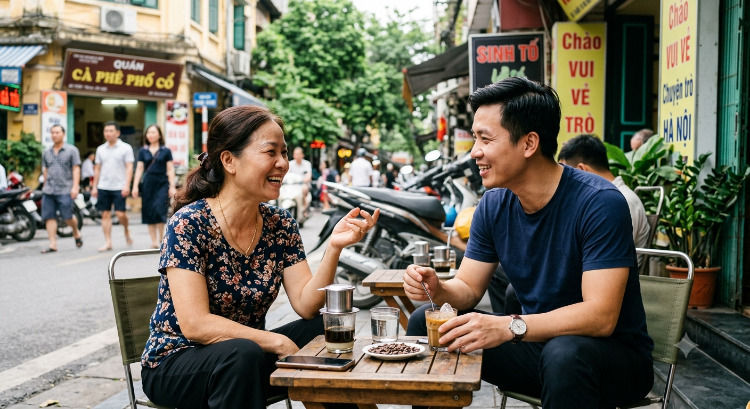
If you meet someone or when you travel to Vietnam, you may expect to hear these questions:
Bạn tên gì?: What's your name? [ban ten zee]
Bạn đến từ đâu?: Where are you from? [ban den tuh dow]
Bạn sinh ra ở đâu?: Where were you born? [ban shin ra uh dow]
Bạn bao nhiêu tuổi?: How old are you? [ban bao nyew twoy]
Bạn đến đây để làm gì?: Why are you here? [ban den day day lam yee]
Bạn làm nghề gì?: What do you do? [ban lam ngeh yee]
Sở thích của bạn là gì?: What are your hobbies? [suh tick kwa ban la yee]
Here are the answers:
Tôi tên là...: My name is... [toy ten la]
Tôi đến từ...: I come from... [toy den tuh]
Tôi sinh ra ở...: I was born in... [toy shin ra uh]
Tôi... tuổi: I'm... years old [toy... twoy]
Tôi đến đây để...: I'm here for... [toy den day deh]
Tôi làm...: I work as... [toy lahm]
Tôi thích...: I'm interested in... [toy tick]
4. Simple Vietnamese phrases to order food
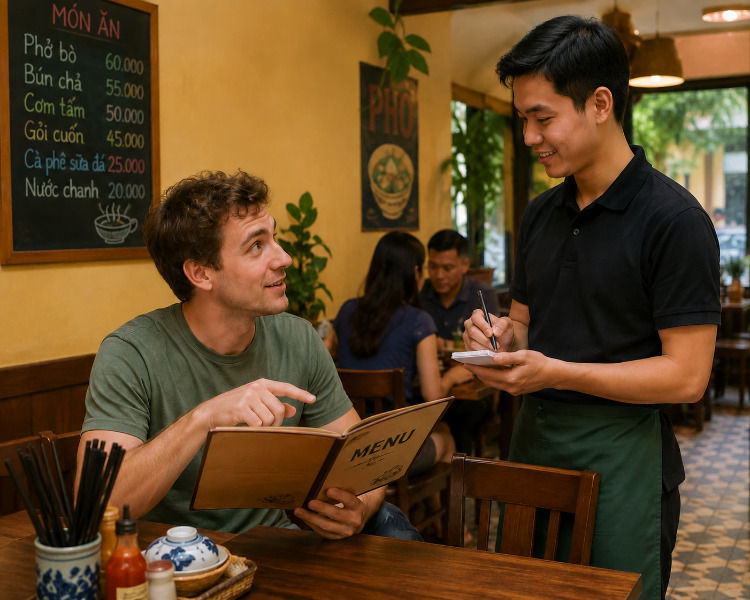
When visiting a Vietnamese restaurant, if you can speak a little Vietnamese to order food, you'll instantly bring a smile to the staff's faces and experience warm, heartfelt hospitality.
Cho tôi xem menu: Menu, please [chaw toy sem meh-noo?]
Đây là món gì? What dish is this? [day lah mohn zee?]
Tôi muốn gọi món*...: I'd like to order.... [toy moo-uhn gohy mohn...]
Cho tôi 2 tô...: I'll have two bowls of... [chaw toy hi toe...]
Ở đây có món*... không?: Do you have... here? [uh day kaw mohn... khomg?]
Cho tôi xin thêm rau được không?: Can I get some more vegetables? [chaw toy sin tem raw deu-uhk khomg?]
Món này ăn chay được không?: Is this dish vegetarian? [mon nay an chay duh-uhk khom]
Tôi muốn tính tiền: The bill, please [toy moo-uhn tin tyen]
*Món means dish, and after món, you can add the specific name of the food or drink you wish to order. Here are some:
Phở bò: beef noodle soup [fuh baw]
Bún bò: beef rice vermicelli [boon baw]
Bánh cuốn: steamed rice rolls [bahn koo-uhn]
Cơm tấm: broken rice [kuhm tuhm]
Bún chả: grilled pork with rice noodles [boon chah]
Cà phê sữa đá: iced coffee with condensed milk [kah feh soo-uh dah]
Nước mía: sugarcane juice [noo-uhk mee-uh]
Trà đá: iced tea [trah dah]
Before you order food or request the bill, you need to get the waiter's attention politely first. In Vietnamese, you use "ơi" to call someone over, so you can say "em ơi" (if (you guess) they're younger than you), or "anh ơi" (male) / "chị ơi" (female) (if (you guess) they're older than you).
5. Basic Vietnamese words for tourists

Traveling to Vietnam without speaking Vietnamese isn't intimidating at all since many local service providers have English-speaking staff, not to mention French, Spanish, Chinese, and many more. However, in urgent cases or when you simply want to immerse yourself in the local culture, learn some basic Vietnamese phrases for travel.
Bạn nói tiếng Anh được không?: Do you speak English? [ban noy tyeng ang duh-ək khohng]
Cho hỏi nhà vệ sinh ở đâu?: Where is the bathroom? [chaw hoy nyah veh sin uh doh-oo]
Tôi để túi xách ở đây được không?: Can I leave my bag here? [toy deh too-ee sahkh uh day deu-uhk khohng]
Cái này bao nhiêu tiền?: How much is this? [kai nay bow nyew tyen]
Ở đây có thanh toán bằng thẻ không? Do you accept cards? [uh day kaw tahnh toh-ahn bahng theh khohng]
Tôi đang tìm...: I'm looking for... [toy dahng teem]
Tôi thử cái này được không?: Can I try this? [toy tuh kai nay deu-uhk khohng]
Cho hỏi quầy tính tiền ở đâu?: Where is the check-out counter? [chaw hoy kway tin tyen uh doh-oo]
Tôi bị lạc đường rồi: I'm lost [toy bee lak duh-uhng zoy]
Tôi yêu Việt Nam: I love Việt Nam [toy yew vyet nahm]
>>> Read more on how to say famous destinations in Vietnamese correctly.
6. Basic Vietnamese words for kids
The basic Vietnamese phrases to teach kids should focus on good manners. In Vietnamese, it's essential for younger people to use respectful language when talking to their elders, so you should teach them how to greet family members properly first.
Dạ con chào ông: Hello, Grandpa [zah kohn chaw ohng]
Thưa mẹ con mới đi học về: Hi Mom, I'm back from school. [thoo-uh meh kohn muh-ee dee hahk veh]
Bà khỏe không bà? How are you, Grandma? [bah khwehh khohng bah]
Con hiểu rồi ạ: Got it [kohn heew roy ah]
For kids, they should be taught to use pronouns correctly to help them address themselves and family members and build good social manners. Show them situations where "I" changes in Vietnamese so that they can naturally build proper polite habits early on.
>>> Discover our free resource library, where parents can find worksheets, stories, and games to make teaching kids more fun.
Why should you learn basic Vietnamese phrases and pronunciation?

Locals warm Up to basic Vietnamese phrases
You might not realize it at first, but using even a little Vietnamese with local vendors completely changes how they interact with you. Vietnamese people notice and appreciate effort, even mispronounced greetings often get a smile, a laugh, or better service/prices.
Travel beyond tourist hotspots
Outside major cities like Sài Gòn, Hà Nội, or Đà Nẵng, English proficiency drops significantly. Basic phrases give you the confidence to venture off the beaten path and explore local neighborhood spots independently. A few basic Vietnamese phrases can spark genuine curiosity and instantly warm up your interactions with locals.
Pronunciation is the hardest part to fix later
Because Vietnamese is a tonal language, a slight shift in pitch completely alters a word's meaning. While vocabulary can be learned anytime, bad pronunciation habits are hard to break once set, so starting with correct tones from day one saves immense frustration later.
How to learn basic Vietnamese phrases for beginners effectively?

Learn the tones along with the words
Since Vietnamese is a tonal language, speaking off-tone, one of the most common mistakes in learning Vietnamese, makes it challenging for other people to understand you. Treat tones as core alphabet letters rather than accents. Record yourself saying target phrases out loud, listen back alongside native recordings, and mark down where your pitch drops or rises incorrectly.
Treat romanized pronunciation as a starting point, not an endpoint
When learning basic Vietnamese phrases for beginners, approximate spellings help at first, but try to slowly transition to the real Vietnamese script and native audio as soon as possible. This is because English letters can't fully capture Vietnamese sounds.
Diacritics and letters like d, đ, x, and ch don't map directly to English equivalents. Relying strictly on standard English phonetics creates stubborn mispronunciations.
Focus on progressive learning and real conversations
Try saying phrases out loud whenever the situation naturally comes up (ordering phở, greeting a neighbor, asking for prices) rather than only in a study session. Real-world repetition removes the delay of translating in your head before speaking. And don't worry, as a beginner, you don't need a 10-minute conversation. A single polite phrase (“Dạ cảm ơn!”) during a routine interaction counts as a successful live repetition.
So now you have the right key words to help you get started on your Vietnamese language journey. With these basic Vietnamese phrases for beginners, you’ll soon find yourself having your first conversation with a native speaker.
📝 Practice time: Try this rearrange game to review all basic phrases you've learned so far!


