Basic Vietnamese Phrases for Travel (with Pronunciation)
Updated: 6 days ago
Savoring a steaming, aromatic bowl of street-side Phở in Hà Nội. Weaving through the vibrant, lantern-lit alleys of Ancient Town Hội An. Immersing yourself in the lively, bustling energy of Hồ Chí Minh City. No matter where your adventures take you in Vietnam, knowing some essential Vietnamese phrases for travel can help your trip run more smoothly and make a memorable, warm impression on the locals, too.
A few basic phrases might just be the reason you decide to fully dive in and learn Vietnamese! In this article, this post will discuss why you should acquire some common Vietnamese phrases for travel. You will also find some of the most essential Vietnamese phrases with pronunciation every traveler should know. Let’s get started!
Why you need to know common Vietnamese phrases for travel

The good news is that you can speak English to local service providers, restaurant waiters, hotel receptionists, or random young students in the city centers of Hà Nội or Hồ Chí Minh. But imagine when you travel further to areas far away from the central hubs and suddenly realize you have no idea where you are. At that moment, would you turn to Google Translate for some machine translation? Of course, it's the first option. Technology helps you with the language, but the nuances cannot be fully conveyed. That is because Vietnamese has a totally different set of pronouns and tones.
Also, if you know some Vietnamese phrases for travel, even short phrases, you can connect with locals, get insider tips, and make your trip feel more like an adventure into Vietnamese culture. Nobody knows a particular locale quite like the locals, and you will have the opportunity to discover plenty of suggestions off the beaten path – anything from nightlife entertainment options, restaurants, lesser-known landmarks, and much more. And what's more, you may get a better deal from a local vendor if you show your effort in haggling in Vietnamese!
Learning a few simple phrases in Vietnamese, you will be able to:
Ask for directions
Ask someone for help finding transportation
Order at a restaurant
Exchange information at the hotel
Ask for help in emergency services
>>> Read more on Is Vietnamese a Good Language to Learn?
Essential Vietnamese phrases every traveler should know (+pronunciation)
1. Greetings and basic Vietnamese phrases for travel

Vietnamese basic greetings are not too hard to memorize, but you just need to work more on the pronunciation since the tones can shift the meaning of the word. Don't worry about making mistakes. Most people will try their utmost to understand you. Try your best and they will be happy to reciprocate!
>>> Explore Pronunciation of Famous Places in Vietnam
2. Asking for directions in Vietnamese
If you're unsure how to get to somewhere, using "... ở đâu?" is the easiest way to ask for directions. Here are a few more phrases that will be helpful for your next trip to Vietnam:
Once you have asked a question, locals will answer you in Vietnamese. Now listen for these keywords:
*In Southern Vietnamese, people prefer to use "quẹo" instead of "rẽ."
Useful vocabulary on the street:
sân bay | airport |
khách sạn | hotel |
nhà vệ sinh | bathroom |
quán cà phê | coffee shop |
nhà hát | theater |
bảo tàng | museum |
bưu điện | post office |
nhà hàng | restaurant |
trạm xe buýt | bus station |
nhà thờ | church |
xe máy | motorbike |
xe hơi / ô-tô | car |
3. Vietnamese phrases for tourists at the hotel

Finally, you've found your hotel and you're ready to check in. Most hotel staff in Vietnam's big cities speak good English, but communication can be harder in rural areas or mountain homestays. These basic Vietnamese phrases for travel will come in handy for better communication.
Useful vocabulary at the hotel:
miễn phí | free |
phụ phí | extra fee |
phòng đơn | single room |
phòng 2 giường đơn | twin room |
phòng giường đôi | double room |
dịch vụ phục vụ tại phòng | room service |
hồ bơi/ bể bơi | pool |
laundry service | dịch vụ giặt ủi |
hành lý | luggage |
lễ tân | receptionist |
4. Vietnamese travel phrases for the restaurant

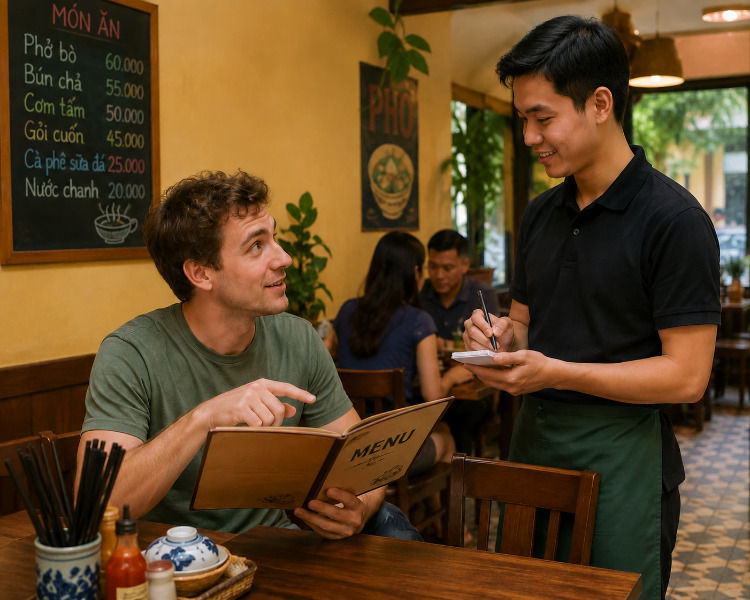
Ordering food is probably the most common scenario you will need to use basic Vietnamese phrases. In Vietnam, there are many restaurants but the best part of Vietnamese cuisine – street food – can only be found on in local street stalls and food markets. And this is exactly when you need to communicate in Vietnamese. Ask for anything by using "Cho tôi..." (literally means "Give me" but functions as "I want").
Useful vocabulary at the restaurant:
rau mùi | cilantro |
hành | onion |
giá/ đỗ | bean sprouts |
tiêu | pepper |
ớt | chilli |
thịt | meat |
đường | sugar |
đá | ice |
không cay | not spicy |
bún | rice vermicelli |
Vietnamese baguette | |
gỏi cuốn | fresh spring rolls |
cà phê đen | black coffee |
cà phê sữa đá | iced coffee with condensed milk |
cà phê trứng | egg coffee |
cơm tấm | broken rice |
bún chả cá | fish cake noodles |
bánh cuốn | steamed rice rolls |
5. Vietnamese phrases for the airport
Airports can be frustrating places. Having to speak a foreign language in an airport can add to the frustration. But here are some Vietnamese phrases that can help you survive any airport experience in Vietnam.
>>> Explore Airport Transfers in Vietnam
6. Emergencies in Vietnamese for tourists
Exploring Vietnam can be fun and exciting, but after all, you never know what could happen when you're overseas. A smart traveler always comes prepared with some emergencies.
7. Fun Vietnamese phrases for travel

Traveling to Vietnam is exponentially more fun when you can share a quick laugh with the locals. Beyond standard greetings, learning a few playful and informal phrases instantly breaks the ice.
How to learn basic phrases effectively

It’s one thing to read this article, and quite another to take the time to memorize Vietnamese phrases to know for travel that will make a difference. It’s best to practice a language every day.
Tones are king
In Vietnamese, pitch defines meaning entirely, making Vietnamese tone fluency far more critical than memorizing traditional spellings. A single syllable pronounced with a rising tone rather than a falling tone completely alters what you are trying to say. Focusing on listening to native sound clips and practicing pitch movement. Make sure you don't just say the word but to make it understandable.
Focus on scenarios
Group your vocabulary around real-world travel situations rather than studying isolated lists of words. Memorizing phrases contextually allows your brain to quickly retrieve the right sentence when standing at a busy night market or ordering street food. This practical approach keeps your study sessions functional and directly applicable to your daily itinerary.
Example:
Ordering food: "Cho tôi một ly cà phê sữa đá." (Give me one iced milk coffee.)
Asking for directions: "Đồn công an ở đâu?" (Where is the police station?)
Use simple sentence formulas
Rather than struggling with complex grammar rules, rely on versatile plug-and-play sentence templates. Learning a few core starter frames allows you to swap out individual nouns or places on the fly, dramatically expanding what you can communicate with minimal effort.
Example:
[Item] + bao nhiêu?: "Bánh mì bao nhiêu?" (How much is the Bánh mì?)
Cho tôi + [Item]: "Cho tôi cà phê đen" (Give me black coffee.)
[Place] + ở đâu?: "Nhà vệ sinh ở đâu?" (Where is the bathroom?)
Once you unlock these foundational Vietnamese phrases for travel, you’ll easily connect with friendly vendors, navigate local markets with ease, and experience authentic hospitality everywhere you go. Win, win, win. What's more, from the very first "Thank you" in Vietnamese, you might just find yourself inspired to dive deeper into learning Vietnamese and unlocking a whole new culture.