Vietnamese Tropical Fruits: Say Your Next Favorite Bite Correctly
Updated: Aug 23
Ordering Vietnamese tropical fruits can feel like a pop quiz you didn't study for. You point, you mumble something close to dứa (pineapple), and the vendor either laughs, corrects you, or hands you a dừa (coconut) that you definitely didn't mean to order. Is this a snack or a spelling bee?
From the creamy sweetness of star apple to the polarizing punch of durian, each fruit comes with its own story, its own way to eat it, and yes, its own tricky pronunciation.
In this guide, we're covering 10 fruits worth trying at least once, plus simple tips to help you say their names like a local. Ready to taste your way through Vietnam?
Common Vietnamese Tropical Fruits in Vietnamese
Vietnam’s lush climate and fertile soils yield an extraordinary bounty of tropical fruits, making fresh produce an essential element of the country’s daily rhythm and culinary soul. Here are the 10 most popular fruits you should know and say correctly.
1. Nhãn – Longan

Sweet, juicy, and translucent, nhãn hides a shiny dark seed inside that's earned it the nickname "dragon's eye" or long nhãn. The prized nhãn lồng variety comes from Hưng Yên (the North), where it's traditionally grown under protective cages — hence the name (lồng). Another popular variety is nhãn xuồng, named after the iconic wooden boats (xuồng) that define life in the Mekong Delta (the South).
How to say Nhãn: Nyahn ("nh" sounds like the "ny" in the word "cayon")
Nhãn: "nh" - "an" - "nhan" - ngã - "nhãn"
2. Chôm chôm – Rambutan
One of the most delicious Vietnamese tropical fruits you can't miss is chôm chôm — bright red and green, covered in soft "hair." Crack it open and you'll find a translucent white fruit with a sweet, slightly tart flavor. Squeeze the shell gently until it splits, then pop the fruit into your mouth. Watch for the smooth seed inside — it doesn't separate from the flesh as easily as lychee, so nibble carefully.
How to say Chôm chôm: Chohm Chohm (say a round "oh" sound and close your lips with an "m" sound)
Chôm: "ch" - "ôm" - "chôm"
3. Thanh long – Dragon Fruit
Bright pink, spiky and wildly eye-catching, thanh long is one of Vietnam’s most iconic tropical treasures. Don't let its dramatic, mythical exterior fool you — inside lies a refreshing, mildly sweet white or deep magenta flesh dotted with tiny, crunchy seeds. Perfect for a quick refreshment on a hot afternoon, this stunning fruit is as delicious as it is camera-ready.
How to say Thanh long: Tahn Lohnng ("long" is different from "lồng" in nhãn lồng above, this time, use a level flat tone)
Thanh: "th" - "anh" - "thanh"
4. Xoài – Mango

Stretching from the tropical orchards of the Mekong Delta to coastal provinces, Vietnam produces a remarkable variety of mangoes, ranging from the buttery, honey-sweet xoài cát to crisp, tart green mangoes xoài xanh. For green mango, cut it into thin strips and dip in muối tôm (shrimp salt) or chili salt — it's a popular street snack that balances tart and salty perfectly.
How to say Xoài: Swai (rhymes with "why," starting with an "sw" sound)
Xoài: "x" - "oai" - "xoai" - huyền - "xoài"
5. Vú sữa – Star Apple
With a name that literally translates to "breast milk," vú sữa gets its unforgettable moniker from the sweet, milky-white juice that flows from its flesh when gently pressed. Beneath its glossy green or purple skin lies a star-patterned cross-section of translucent, custard-like fruit. Creamy, smooth, and delicately fragrant, this Vietnamese tropical fruit offers a unique tropical experience that feels as much like a luscious dessert as it does a fresh fruit.
How to say Vú sữa: Voo Suh-uh (voo like "voodoo"; suh-uh is a soft, short double sound)
Vú: "v" - "u" - "vu" - sắc - "vú"
Sữa: "s" - "ưa" - "sưa" - ngã - "sữa"
6. Sầu riêng – Durian

The legendary "King of Fruits." Its smell is famously polarizing (some love it, some can't get near it), but underneath that spiky shell is rich, buttery, custard-like flesh that converts even skeptics. The name sầu riêng poetically translates to "private sorrow," tied to a well-known romantic legend.
How to say Sầu riêng: Sow Ree-eng (sow rhymes with "cow"; ree-eng like "ree" + "eng")
Sầu: "s" - "âu" - "sâu" - huyền - "sầu"
Riêng: "r" - "iêng" - "riêng"
7. Đu đủ – Papaya
Soft and bright orange, papaya is mild, easy to eat, and gentle on the stomach — making it one of the greatest Vietnamese tropical fruits for easing into tropical eating if you're new to it. While lush đu đủ chín (ripe papaya) is enjoyed as a refreshing afternoon treat or healthy dessert, đu đủ xanh (crisp green papaya) forms the crunchy backbone of iconic savory dishes, from tangy street-side salads to the classic pickled vegetables served with sizzling grilled pork.
How to say Đu đủ: Doo Doo (like the English phrase "doo-doo," but the second "doo" is marked with a dipping-rising mark and its tone dips down then rises back up.)
Đu: "đ" - "u" - "đu"
đủ: "đ" - "u" - "đu" - hỏi - "đủ"
8. Bòn bon – Langsat
Clustered closely together on woody branches, these small, translucent-fleshed fruits feature a delicate balance of sweet and mildly tangy notes, often compared to a blend of grape and grapefruit. Widely enjoyed across Vietnam during the late summer months, bòn bon is as much a beloved street-side snack as it is a nostalgic marker of warm, sunny afternoons.
How to say Bòn bon: Bawn Bawn (rhymes with "dawn," said twice, the first "bawn" is marked with a low-falling tone.)
Bòn: "b" - "on" - "bon" - huyền - "bòn"
Bon: "b" - "on" - "bon"
9. Dừa – Coconut

From the vast, emerald coconut groves of Bến Tre in the Mekong Delta to sun-drenched coastal beaches, dừa is woven into the fabric of everyday life, making this Vietnamese tropical fruit an essential part of local culture. Fresh, sweet nước dừa (coconut water) serves as the ultimate natural refresher against the tropical heat, while rich nước cốt dừa (coconut milk) forms the creamy backbone of countless Vietnamese dishes, traditional desserts, and savory braises.
How to say Dừa: Yuh-uh (Southern accent) — a soft, short "yuh" sound with a low-falling tone. Compare to Dưa in dưa leo (cucumber) or dưa hấu (watermelon).
Dừa: "d" - "ưa" - huyền - "dừa"
10. Mít – Jackfruit
If mango is the crown jewel of tropical fruit, mít (jackfruit) is the giant of the Vietnamese orchard. Famous for its spiky green exterior, intoxicating aroma, and sweet, golden pods, jackfruit occupies a special place in Vietnam's vibrant culinary landscape. Eat the pods fresh on their own, or look for dried jackfruit chips for a sweet, crunchy snack that travels well.
How to say Mít: Meet (exactly like the English word "meet" but without the final "t" sound)
Mít: "m" - "it" - "mít" - sắc - "mít"
Tips to pronounce the Vietnamese tropical fruits correctly
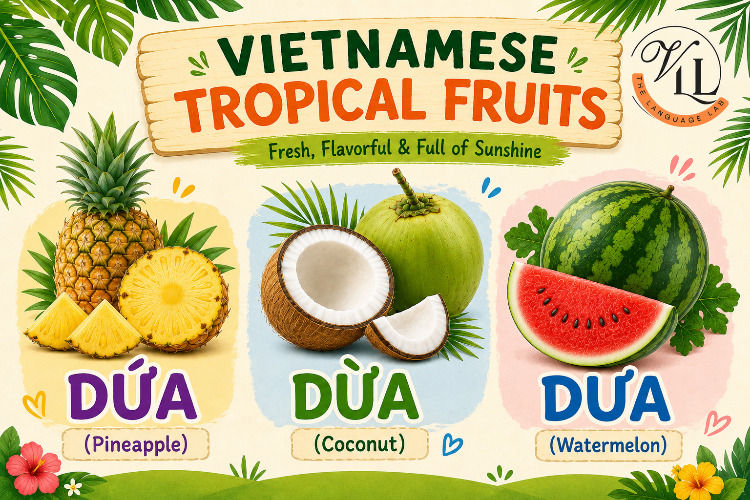
Did you notice the changes in pitch in which the words are pronounced? First, you need to master the Vietnamese 6 tones to differentiate between similar written words, and then perhaps delve into the local dialects (northern and southern).
1. Master the tones to say Vietnamese tropical fruits
Vietnamese uses six tones, and each one changes the meaning of a word completely — even if the letters look the same. A flat tone, rising tone, falling tone, and dipping tone can turn one syllable into four different words.
Look at the tone markers and tone description below:
Tone Mark (dấu) | Tone Mark Name | Description | Tone (thanh điệu) | Example |
không dấu | No visible marking | thanh ngang "flat tone" | dưa (cucumber or pineapple); bơ (avocado); cam (orange) | |
` | dấu huyền | A descending accent marker over a vowel | thanh huyền "falling tone" | xoài (mango); dừa (coconut); |
´ | dấu sắc | An ascending accent marker over a vowel | thanh sắc "rising tone" | táo (apple); chuối (banana); khế (starfruit) |
̉ | dấu hỏi | Looks like a ? without the dot, above a vowel | thanh hỏi "dipping rising tone" | bưởi (pomelo); vải (lychee); ổi (guava) |
~ | dấu ngã | A tilde/squiggly mark above a vowel | thanh ngã "broken rising tone" | nhãn (longan); mãng cầu (custard apple) |
. | dấu nặng | A dot under a vowel | thanh nặng "heavy tone" | mận (plum) |
Get the tone right; otherwise, a local might not understand you at all, or worse, think you said something totally unrelated.
Struggling with pronouncing words with correct tones? Practice makes perfect. These free online resources can take you from basic Vietnamese phrases to reading the news like a native speaker.
2. Skip the final sound
One common habit that gives away a non-native speaker is over-pronouncing the ending of a word. In Vietnamese, many final consonants (like -nh, -ng, -c, -t) are softened, clipped, or barely audible — very different from how English fully pronounces word endings.
Example: thanh long → A non-native speaker might say "thahn-G long-G," emphasizing the final -nh and -ng with hard releases. A native speaker lets the voice resonate softly in the nasal cavity, closing the throat gently on long without popping a hard "G" sound at the end.
Say the word shorter and softer than feels natural. If it feels like you're cutting the word off too early, you're probably doing it right.
Read more on Common Mistakes Non-Native Speakers Usually Make
3. Learn different dialects
Vietnam has two major dialect regions (actually three: northern, central, and southern, but the central one is less widely taught to learners due to its distinct, highly localized accents and unique vocabulary). Therefore, fruit names can shift depending on where you are. As we mentioned earlier, dứa (North) becomes thơm or khóm (South), and roi (North) becomes mận (South).
Beyond vocabulary, the accent itself changes too: Northern Vietnamese tends to have crisper, more distinct tones, while Southern Vietnamese often softens or blends tones together, making it sound smoother but occasionally trickier for beginners to distinguish. For example, "d" in dứa sounds like "z" in the northern accent and "y" in the southern accent.
If you're traveling to a specific region, focus on learning that area's dialect first — you'll fit in better and avoid confusing looks at the local market.
Whether you are wandering through a bustling morning market in Hà Nội or floating along a canal in the Mekong Delta, exploring Vietnamese fruits is one of the richest ways to experience the country’s culture. By understanding how these fruits are pronounced, you unlock far more than just delicious flavors.
Think you know many Vietnamese tropical fruits? Take this guessing game to test your knowledge and see how many you can score!


